Picasso Museum Malaga 2026: Tickets, Hours & What to See Inside
Picasso was born two streets from this museum. The building — a 16th-century Andalusian palace — holds over 200 works donated by his daughter-in-law and grandson, spanning every period of his output. It's not a greatest-hits collection assembled for tourists. It's a family collection, which gives it a different weight.
Quick answer: €9 general admission (free last 2 hours every Sunday). Open daily — no Monday closures. Book online for July–August; walk-in fine the rest of the year. Allow 60–90 minutes.
Quick Takeaways
- ✓General admission is €9. Reduced (seniors 65+, students under 26, Youth Card holders) is €7. Children under 17 enter free.
- ✓Every Sunday the last 2 hours before closing are free — e.g. 17:00–19:00 in summer. Plan around this if budget matters.
- ✓Free on specific days: 28 February (Andalusia Day), 18 May (International Museum Day), 27 September (World Tourism Day), 27 October (Museum Anniversary).
- ✓The museum is open every day of the year except 25 December, 1 January, and 6 January. No Monday closures — unusual for a Spanish museum.
- ✓Online booking is recommended in July–August and at weekends — tickets can sell out. The rest of the year, walk-in is usually fine.
- ✓Special hours on 24 and 31 December, and 5 January: 10:00–15:00 only.
The Picasso Museum fits naturally into a morning that also covers the Alcazaba and Roman Theatre — both are within 10 minutes on foot. The 3-day Malaga itinerary shows the most efficient sequence. For everything else you need to plan your visit, the Malaga travel guide is the starting point.
July and August weekends — including the popular Sunday free entry window — fill fast. Walk-up tickets occasionally sell out on Saturday and Sunday afternoons in peak season. If your visit falls on a summer weekend, book online now. Two minutes online saves 40 minutes in the queue.
What's Inside the Picasso Museum
The Museo Picasso Málaga is housed in the Palacio de Buenavista, a 16th-century Andalusian Renaissance palace. The building itself is worth attention — the courtyard, the carved stone arches, the Moorish elements visible in the lower levels where excavations have exposed the earlier structure beneath.
The permanent collection of over 200 works was donated by Christine Ruiz-Picasso (wife of Paulo, Picasso's son) and Bernard Ruiz-Picasso (his grandson). This is the key context: the collection reflects what the family lived with, not what curators selected for a retrospective. It covers every major period — Blue Period, Rose Period, Cubism, Neoclassicism, Surrealism — and includes paintings, sculptures, ceramics, and drawings.
The Permanent Collection
The works are displayed chronologically across multiple rooms on two floors. The early works — painted in Malaga and Barcelona before Picasso left for Paris — are particularly interesting in context: you're standing in the city where they were made.
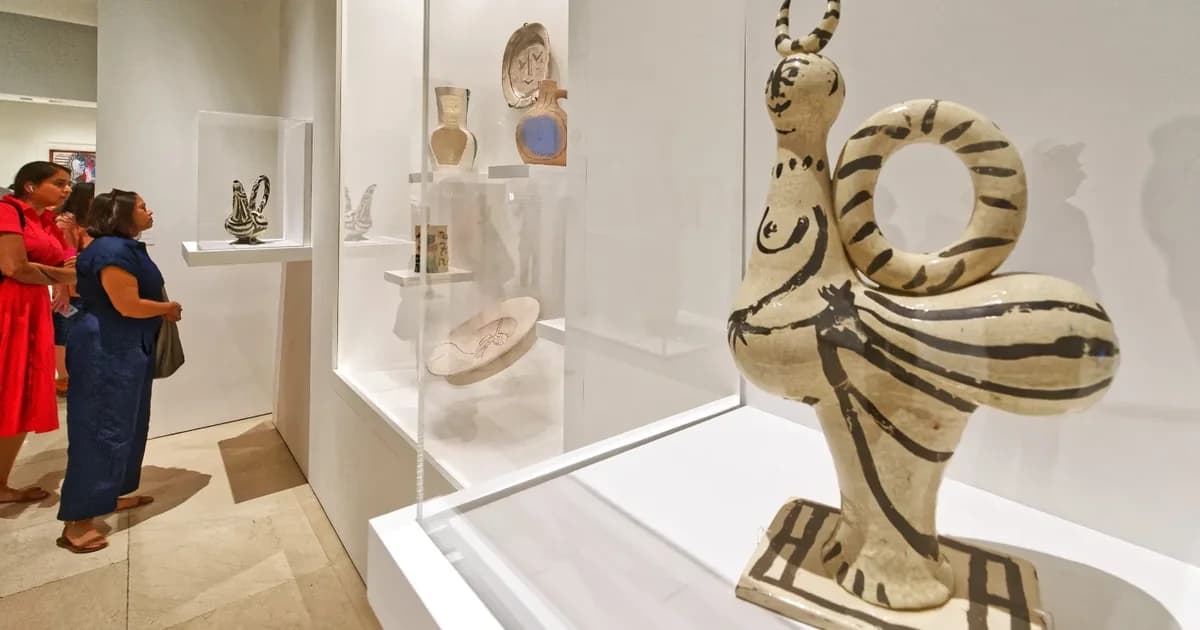
The Cubist works (roughly 1908–1920) are the collection's strongest section. The ceramics, often overlooked in larger Picasso retrospectives, are displayed prominently here and repay close attention — they show a different register of his thinking about form and surface.
The Palace Archaeology
The lower levels of the palace expose Phoenician, Roman, and Moorish remains found during the building's renovation. These are viewable as part of the museum visit — a reminder that the ground beneath the historic centre has been continuously occupied for 3,000 years.
It adds 10–15 minutes to the visit and is worth doing on the way in or out.
Temporary Exhibitions
The museum runs major temporary exhibitions alongside the permanent collection. These require a separate ticket or an upgrade — check the official site (museopicassomalaga.org) before visiting to see what's on. In some years the temporary exhibition has been as strong as the permanent collection.
The museum shop is better than average for a Spanish museum — serious art books, quality reproductions, and items that aren't available elsewhere in Malaga. The shop closes 15 minutes before the museum itself, so plan accordingly if you want time to browse.
Tickets, Prices & Opening Hours 2026
Opening hours by season:
- July–August: 10:00–20:00 (last entry 19:30)
- March–June and September–October: 10:00–19:00 (last entry 18:30)
- November–February: 10:00–18:00 (last entry 17:30)
The museum is open every day except 25 December, 1 January, and 6 January. On 24 and 31 December and 5 January, hours are 10:00–15:00 only. There are no regular Monday closures — this sets it apart from most museums in Spain.
Galleries are cleared 10 minutes before closing time. Last entry is 30 minutes before closing.
Free Entry — When and How
The most useful free entry window is every Sunday. The last two hours before closing are free — which means 17:00–19:00 in summer, 17:00–19:00 in spring/autumn, and 16:00–18:00 in winter.
Sunday free entry is genuine — no booking required, just queue at the box office. In summer, the queue forms around 16:45. Arrive at 16:30 to be near the front and still have a full two hours inside. This is the most underused visitor strategy at the museum.
Additional free days in 2026:
- 28 February — Day of Andalusia
- 18 May — International Museum Day
- 27 September — World Tourism Day
- 27 October — Museum Anniversary (commemorating the 2003 inauguration)
On these days, normal opening hours apply and no booking is required. They can be busy — particularly 18 May, which attracts a local crowd.
Self-Guided Visit vs Guided Tour
The permanent collection is well-labelled in Spanish and English. A self-guided visit with the audio guide (available at the entrance) is sufficient for most visitors — the chronological layout makes the evolution of Picasso's work easy to follow without external narration.
A guided tour adds value specifically for visitors who want the biographical context woven into the works. Picasso's relationship with Malaga, his early influences, the specific circumstances of individual pieces — a good guide covers this in ways that room labels don't.
Choose this if...
Avoid this if...
Combining the Picasso Museum with Other Sites
The museum sits at the centre of a triangle that includes the Alcazaba, the cathedral, and the Roman Theatre — all within 10 minutes on foot. This is the most concentrated cluster of significant sites in Malaga, and a morning that covers all three is entirely achievable.
The natural sequence: Roman Theatre (free, 10 minutes) → Alcazaba (€3.50, 60–75 minutes) → Picasso Museum (€9, 60–90 minutes). Total cost: €12.50. Total time: a morning.
For a longer cultural day, the historic centre walking tour adds the cathedral, the Atarazanas Market, and the Pompidou Centre in the afternoon. The 5-day Malaga itinerary shows how to pace this across multiple days without museum fatigue.
There is no combined ticket for the Picasso Museum and Alcazaba — they are separately operated. Buy tickets at each entrance.
Getting There
The museum entrance is at Calle San Agustín 8, in the historic centre. It's a 5-minute walk from the Alcazaba, 10 minutes from the cathedral, and 15 minutes from the port.
There's no practical reason to take public transport from anywhere in the historic centre — the walk is flat and well-signed from the main tourist route.
From the train station or further out: Bus 35 stops on Paseo del Parque (5 minutes' walk), and the metro's closest stop is Alameda, a 10-minute walk. The public transport guide has full route details.
Picasso's birthplace — Casa Natal de Picasso, now a foundation with a small exhibition — is on Plaza de la Merced, 5 minutes' walk from the museum. Entry to the ground floor is free. It's worth a brief stop before or after the main museum visit.
FAQ
How much does the Picasso Museum cost in 2026?+
Is the Picasso Museum free on Sundays?+
Do I need to book in advance?+
Is the museum open on Mondays?+
How long does the Picasso Museum take to visit?+
Is the Picasso Museum suitable for children?+
What is the difference between the Picasso Museum and Picasso's birthplace?+
Read Next
 🎭 Activities
Roman Theatre Malaga 2026: Tickets, Hours and What to Expect
Free, atmospheric, and five minutes from the Cathedral – the Roman Theatre is the easiest historic site in Malaga to add to any itinerary. Here's everything you need to know.
 🎭 Activities
Malaga Nightlife 2026: Best Bars, Clubs & Where Locals Actually Go
Malaga nights start late, run long, and cost less than you'd expect. Here's where locals actually go – and what's only there for the tourists.
 🎭 Activities
Flamenco Shows in Malaga 2026: Best Tablaos and Honest Guide
From intimate tablaos in the old town to dinner-and-show packages near the port – the honest guide to flamenco in Malaga for 2026, with prices and booking tips.